
Professional Behaviors
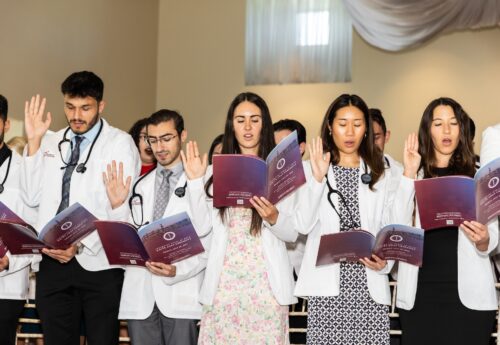
To be entrusted to care for patients, whether as medical students under direct supervision or
later as residents, under indirect supervision, trainees must demonstrate professionalism at all
levels of medical education. At RUCOM, the following professional behaviors are assessed
for all medical students:
Respect: Demonstrates regard for others, including patients, families, peers,
interprofessional collaborators, faculty, staff, and self in all teaching and professional
environments. Embraces shared decision-making, considering patient preferences, values,
and experiences.
Curiosity: Shows a commitment to proactively gather information from diverse sources.
Perceives details and patterns; experiments creatively with different solutions, approaches, or
frameworks towards innovative solutions.
Compassion: Actively listens and responds with empathy and equanimity to the emotions of
others facing profound human experiences. Demonstrates emotional regulation, non-
judgmental support, and setting healthy boundaries that prioritize self-compassion.
Beneficence: Prioritizes the health, well-being, and interests of others in the practice of
medicine. Addresses others’ needs promptly and effectively in roles as trainee, collaborator,
scholar/educator, advocate, communicator, and leader.
Discernment: Recognizes personal and professional responsibilities, as well as the limits of
their knowledge and skills. Engages in self-reflection to apply skills appropriately, balancing
the needs of self and others.
Conscientiousness: Shows thoroughness in data collection, dependability in task
completion, and sets realistic, specific goals and actionable plans to achieve them. Practices
civility, self-discipline, and accountability.
Critical Thinking: Approaches problems with analytical and investigative skills. Utilizes
sound and valid scientific and statistical reasoning, logical evaluation, and inference.
Integrity: Commits to the study and practice of medicine with honesty, transparency, and
trust-building. Demonstrates truthfulness and self-awareness in roles as a trainee,
collaborator, scholar/educator, advocate, communicator, and leader.
Humility: Maintains confidence appropriate to level of training, balanced with a willingness
to learn from others and respect for evidence and truth. Actively sets their own learning goals
and is open to giving, receiving, and acting on fair feedback.
Adaptability: Demonstrates flexibility, resilience, and teamwork to remain effective in
response to interpersonal, systemic, institutional, and structural changes. Manages ambiguity
and uncertainty with emotional regulation and courage.
Fairmindedness: Practices positive regard and open-mindedness toward others.
Demonstrates impartiality, respect, and hospitality in roles as a trainee, collaborator,
scholar/educator, advocate, communicator, and leader.
Excellence: Strives to actualize full potential across all roles, including trainee, collaborator,
scholar/educator, advocate, communicator, leader, and medical expert. Shows grit,
determination, and tenacity in achieving goals.