
Doctor of Nursing Practice Programs at Roseman University
Become a CRNA or FNP through two high-impact Doctor of Nursing Practice (DNP) pathways.
Advance your Career in Nursing & Practice at the Highest Level
Choose from our DNP in Nurse Anesthesia (DNPNA) or Master of Science in Nursing—Family Nurse Practitioner/Doctor of Nursing Practice—Family Nurse Practitioner (MSNFNP/DNPFNP), both built for BSN-prepared nurses ready to lead.
Roseman University of Health Sciences is a non-profit, private institution of higher learning focused exclusively on training the next generation of undergraduate and graduate-level healthcare professionals who serve, collaborate, and set new standards in their communities and within their professions.

Roseman University is the college with the highest earners in Nevada.*
*2026 Data collected from College Scorecard, an initiative of the U.S. Department of Education that compiles reliable data on colleges and universities, allowing users to search and compare colleges based on various indicators like costs and earnings.
Get Connected with Admissions Today
Our Programs
Ready to advance your nursing career? Whether you’re pursuing a path as a Certified Registered Nurse Anesthetist (CRNA), aiming to practice as a Family Nurse Practitioner, lead in administrative roles within healthcare systems, teach in academia, or conduct and translate evidence-based research — our programs are designed for BSN-prepared nurses ready to reach the highest level of practice. With a DNPNA or MSNFNP/DNPFNP degree from Roseman, you’ll be prepared to answer the national call to elevate nursing education to the doctoral level. Join more than 9,500 Roadrunners making a lasting impact in healthcare. Now is the time to take the next step for your career and make a difference in the lives of others.
Nevada ranked among the top 5 states with the highest-earning college graduates. Roseman University is the college with the highest earners in the state.*
*2024 Report by DegreeChoices.com with data collected from College Scorecard, an initiative of the U.S. Department of Education that compiles reliable data on colleges and universities, allowing users to search and compare colleges based on various indicators like costs and earnings.
DNP in Nurse Anesthesia (DNPNA)
Specialize your skills with a DNPNA Degree. Become a CRNA.
Program Duration: 36 months (full-time, year-round)
Delivery Format: Hybrid-online
Campus Location: Online, at clinical sites, and in Henderson, NV
Start Date & Applications: Start July 2027. Now accepting applications.
Career Outlook: CRNA mean salary: $231,700; job growth: 40% over 2023-2033*
Why Choose This Pathway: Prepares you to sit for the NCE for CRNAs
*Data from U.S. Bureau of Labor Statistics Occupational Employment and Wages, May 2024 for 29-1151 Nurse Anesthetists. Available from: https://www.bls.gov/oes/current/oes291151.htm#(2)
Master of Science in Nursing—Family Nurse Practitioner/Doctor of Nursing Practice—Family Nurse Practitioner (MSNFNP/DNPFNP)
Earn Your Doctor of Nursing Practice, and your MSNFNP, along the way.
Program Duration: Thirty-one (31) months (Includes the 19-month MSNFNP curriculum)
Delivery Format: Online with two (2) short residency experiences and in-person at the student’s clinical site for clinical experiential blocks (MSNFNP) & one (1) short residency experience, and in-person at the student’s practicum site for doctoral project quality improvement project (DNPFNP)
Campus Location: Online; clinical practicum at student’s site; interprofessional training
Start Date & Applications: Start July 2026. Now accepting applications.
Career Outlook: NP annual mean wage: $132,000; NPs ranked as the third fastest-growing occupation (2023-2033)*
Why Choose This Pathway: Roseman’s MSNFNP/DNPFNP allows students to complete both the MSNFNP and DNPFNP degrees in less than three years, enabling students to begin their DNPFNP coursework while concurrently pursuing their FNP licensure.
Curriculum Highlights
- Year 1: In Year One (1) the didactic coursework will be mostly delivered via synchronous and asynchronous online courses, focusing on foundational science and anesthesia concepts. The didactic content will provide foundational science courses, anesthesia courses and core advanced practice coursework.
- Year 2: In Year Two (2) the curriculum introduces a longitudinal clinical focus along with continuation of synchronous and asynchronous online courses. Students can fulfill their clinical rotations at various sites located in-state, or out of state in the U.S., as assigned by the College. Didactic coursework will include DNP essentials coursework and core advanced practice coursework with the focus shifting toward the DNP scholarly project and progressive anesthesia skill acquisition throughout the year.
- Year 3: In Year Three (3) the program will be focused on full-time clinical rotations, final DNP essentials coursework, transitioning to an advanced practice nursing role and focus on NCE reviews. The curriculum will culminate in mock NCE exams and simulation intensive for crisis resource management in peri-anesthesia care.
- Year 1: Year 1 didactic material will be delivered hybrid-online focusing on core advanced practice coursework and a blended clinical and didactic curriculum, with clinical experiential learning blocks focusing on Adults, Women’s Health, Pediatrics, and the Family.
- Year 2: In the second year, a mix of DNP essential coursework, healthcare informatics, organizational management, global health, population health, and leadership. The student will continue with longitudinal experiential coursework to complete the required 750 clinical hours for the MSNFNP degree. Towards the end of Year 2, students will be eligible to earn their MSNFNP. Clinical placements are arranged in partnership with the College, students, and clinical sites and are guaranteed within Nevada and Utah. Placements in other states may be secured with appropriate approval and collaboration among the College, student, and clinical site. Students progressing through the DNP degree are required to complete an additional 250 approved indirect patient-care practicum hours that continues into Year 3.
- Year 3: The final year of the DNPFNP is spent earning final practicum hours, as well as completing Evidence-Based Practice I, and II as well as the Doctoral Project Practicum and Seminar, focusing on the implementation, evaluation, and dissemination of the scholarly project.
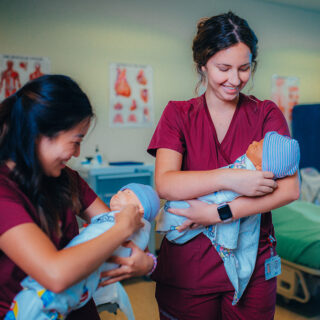
At Roseman we wear our hearts on our sleeves.
We believe compassion should be part of the curriculum. We bring innovation to patient-centered care. We solve human health challenges through research and discovery. We create programs to help people learn, heal and thrive. We believe that the heart and science of healthcare are two halves of one mission. At Roseman, compassion and empathy have been long intertwined with delivering exceptional healthcare to the communities we serve. In everything we do, we unite the heart and science of healthcare.
What makes Roseman different?
Our founders approached learning in a different way. They recognized that every student has a different learning style and that adult learners may need to be engaged differently. They also believed that every student can succeed and compete at a very high level if given the right tools and training to do so. Breaking down barriers and increasing communication and partnership between student and teacher are at the core of success, proficiency and content mastery. Student-to-student collaboration develops healthcare professionals that work in teams so that the patient has the very best chance of a good outcome.
The core principles behind this difference are:
- An educational system in which all students can realistically attain high levels of achievement. We do not place emphasis on grades, rather on achievement of curricular outcomes.
-
An educational experience that goes beyond memorization of facts. We believe in the concept of deep learning and mastery of content that leads to understanding and the ability to apply knowledge and make wise decisions.
-
An educational system that makes better use of time. We utilize the “block system” of curricular design, which provides students with the opportunity to study one content area intensely and master it without distractions from other subjects.
-
A curriculum that utilizes and is supported by technology. We believe that technology holds a remarkable potential to stimulate thinking and learning, as well as being an effective tool for acquiring, evaluating and utilizing new knowledge.
-
An educational experience that values and responds to the needs of students and encourages teamwork and communication. Our curriculum places a premium on active learning in a noncompetitive, collaborative environment.
-
A curricular design that stresses the importance of early exposure to the profession. We believe in building basic skills early by exposing students to early practice experiences.
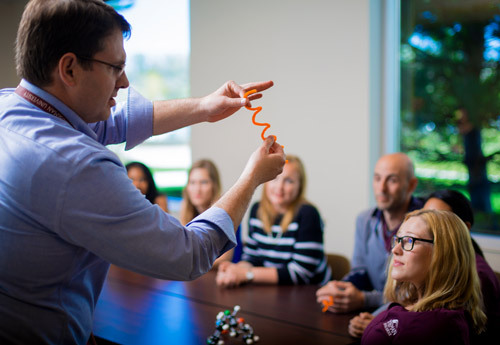
Six-Point Mastery Learning Model®
Roseman University strives to produce competent graduates in an educational environment that ensures high levels of achievement from all students and fosters cooperation and collaboration in the learning process. This is the concept of mastery learning.

Classroom As Teacher

Block Curriculum

Active & Collaborative Learning

Competency-Based Education

Assessment Learning

Early Experiential Learning